
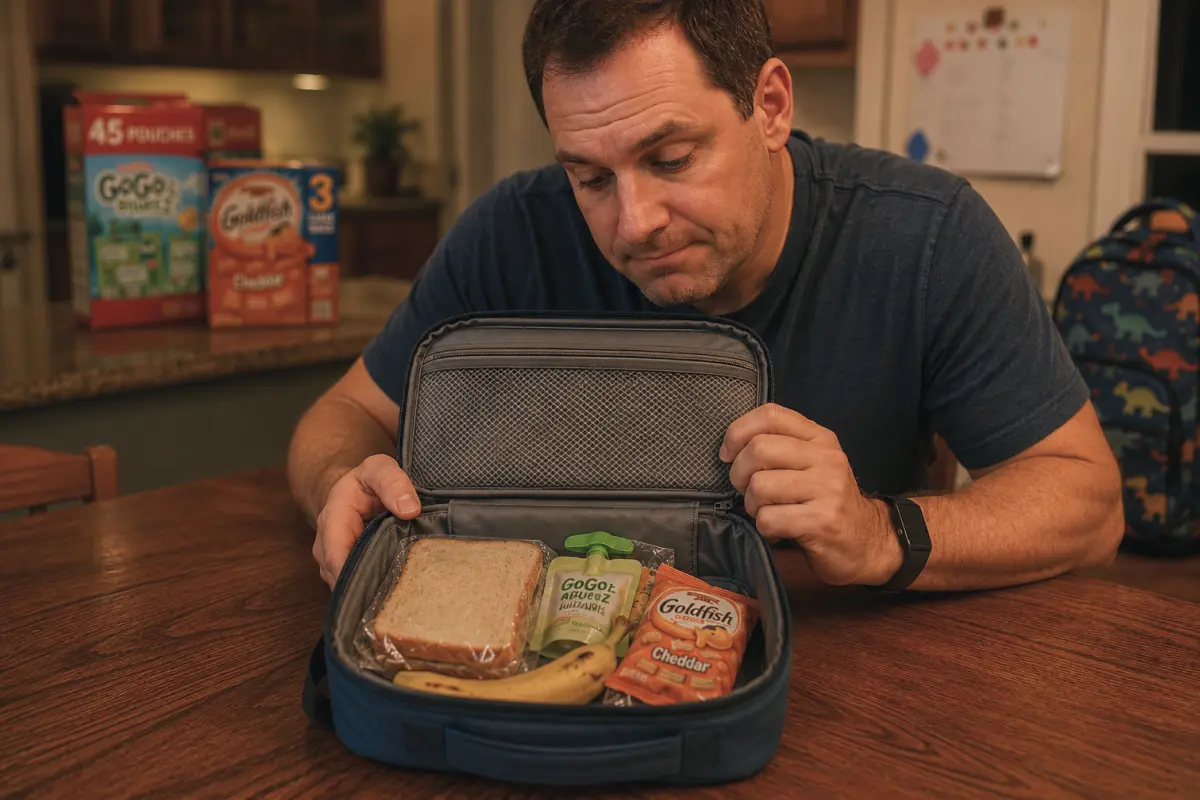
Every September I do the same thing.
I go to Costco at the end of August. I buy large packs of everything the kids ate all June and July. Stack it in the pantry. First week of school — the lunchbox comes back almost full. Second week — same thing.
This happens every year.
And every year we start from scratch.
The worst part isn't even that the kids are hungry. The worst part is opening the lunchbox in the evening and finding the same sandwich nobody touched.
The problem isn't the list
Search "back to school grocery list" and you'll get dozens of options. String cheese. Goldfish. Granola bars. GoGo Squeez. These are good products. But they're abstract — they know nothing about your specific child.
Your kid only eats cheddar Goldfish in the orange bag, not pretzel and not colors. She drinks GoGo Squeez apple but not mixed berry. She ate a certain yogurt all spring — and then suddenly stopped in August.
None of that lives on any generic checklist. It lives in your head. And every year some of it gets lost.
The problem isn't that you don't know your child. You do. It's just that after nine months nobody remembers which yogurt disappeared every day and which one kept coming home untouched.
Memory is a terrible database.
One parent wrote on Reddit: "Something worked last year but I forgot what — back to experiments, back to full lunchboxes." Another: "Bought a variety, the kid picked 1-2 things and stopped. Fridge full of expired stuff kids suddenly refused."
Why the first week of school is so hard
Going back to school isn't just a new schedule. For a picky eater, it's a new context for eating.
At home there's time. It's quiet. You're there to open the packaging. At school it's 10-15 minutes, noise, friends at the table. School lunch in that context is a completely different challenge. A snack your kid eats without question at home might not work at school simply because it's hard to open one-handed, or because it looks "weird" compared to what everyone else has.
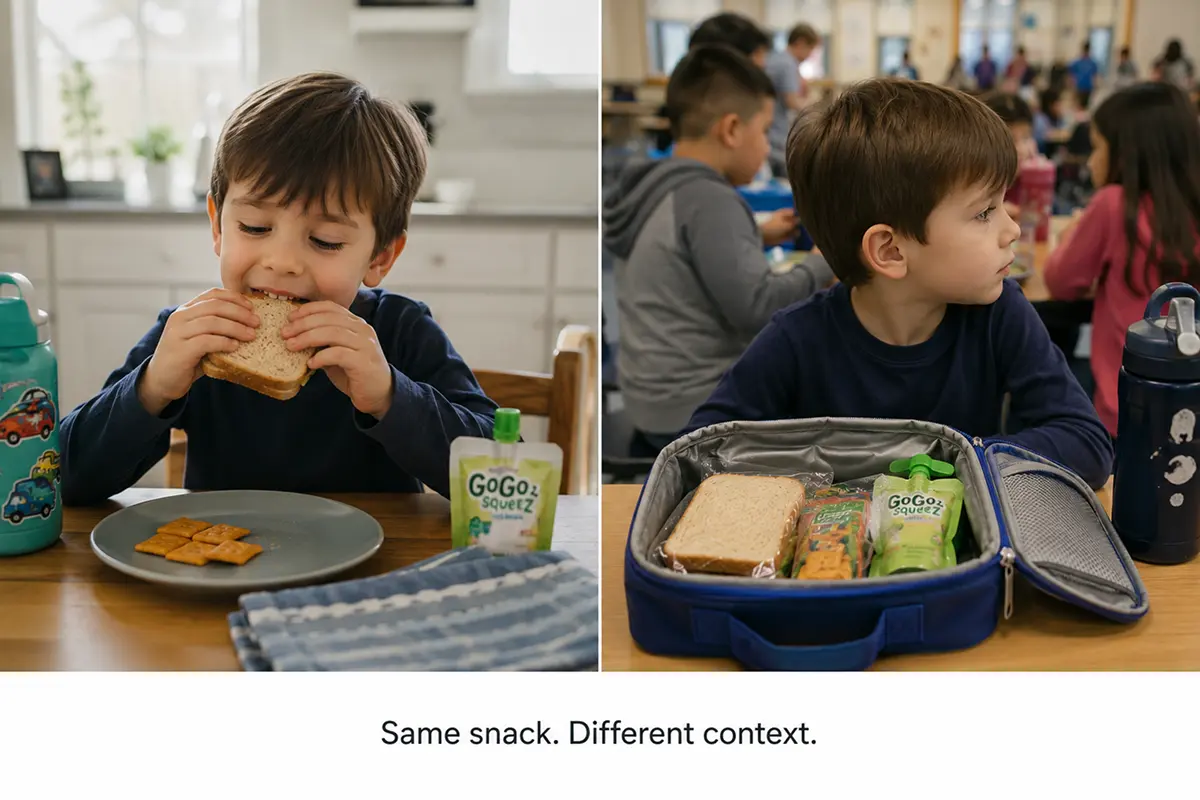
And if your child is starting full-day kindergarten for the first time — it's a double hit. "Picky eater plus no time equals failure," one dad summed it up on r/kindergarten.
There's another classic situation: mom knows what works and what doesn't. Dad went shopping alone — grabbed "healthy" back-to-school snacks without checking. That afternoon the teacher quietly mentioned, "She didn't really eat today."
It's not that dad isn't trying. It's that the knowledge of what a child will actually eat at school lunch often lives in just one parent's head. And as long as it stays there, the problem doesn't go anywhere.
What actually works in most lunchboxes
Over time I noticed a pattern. The snacks that disappeared weren't necessarily the healthiest or the most expensive. They were simply the ones my kids could open quickly and already trusted.
For younger kids that usually means something familiar and no-fuss — a pouch, a small bag of crackers, a piece of fruit that doesn't need cutting. For older kids, what other children are eating starts to matter more than the snack itself. A homemade bento that would be perfect at home can come back full if it looks "different" at the cafeteria table.
None of this is a rule. It's a starting point. Your child's list will be different — and the only way to build it is to track what actually comes back empty. More on school lunch ideas for picky eaters and what to do when the healthy snacks come home uneaten.
What you actually need before the first day of school
Not a new grocery list. Answers to specific questions about your specific child.
What will she reliably eat at school — not at home, but at school? This is a shorter list than you think. Start there.
What worked last school year? Not over summer — specifically at school. Summer and school lunch are different contexts.
What's the packaging like? Can she open it herself in 30 seconds? If not, the back-to-school snack will come back untouched even if she's hungry.
What are the classroom rules? Peanut-free? Tree nut-free? Find out before you stock up. Buying a pile of peanut products and having to throw them away is a classic August mistake — more on peanut-free school snacks that picky eaters will actually eat.
Have her tastes changed since summer? Test new products at home before the first day. School is not the place for first attempts.
How to stop starting from scratch every September
We realized we needed a system, not another note in the phone.
I started keeping track after school pickups — what came back in the lunchbox, what disappeared. What the kids asked for again on Saturday morning. After a few weeks I had something I'd never had before: a real picture of what my kids actually eat — not what I hope they eat, but what reliably disappears from the school lunch.
Notes first. Then a spreadsheet. Then I realized my wife didn't have access to any of it when she went to the store.
That's how Favory came about. You scan a product at the store and see how each family member has already rated it. CAN BUY means someone in the family has already tried it and liked it. STOP means you're probably about to waste money. When September comes around — you already have a list of what actually worked for school lunch and school snacks.
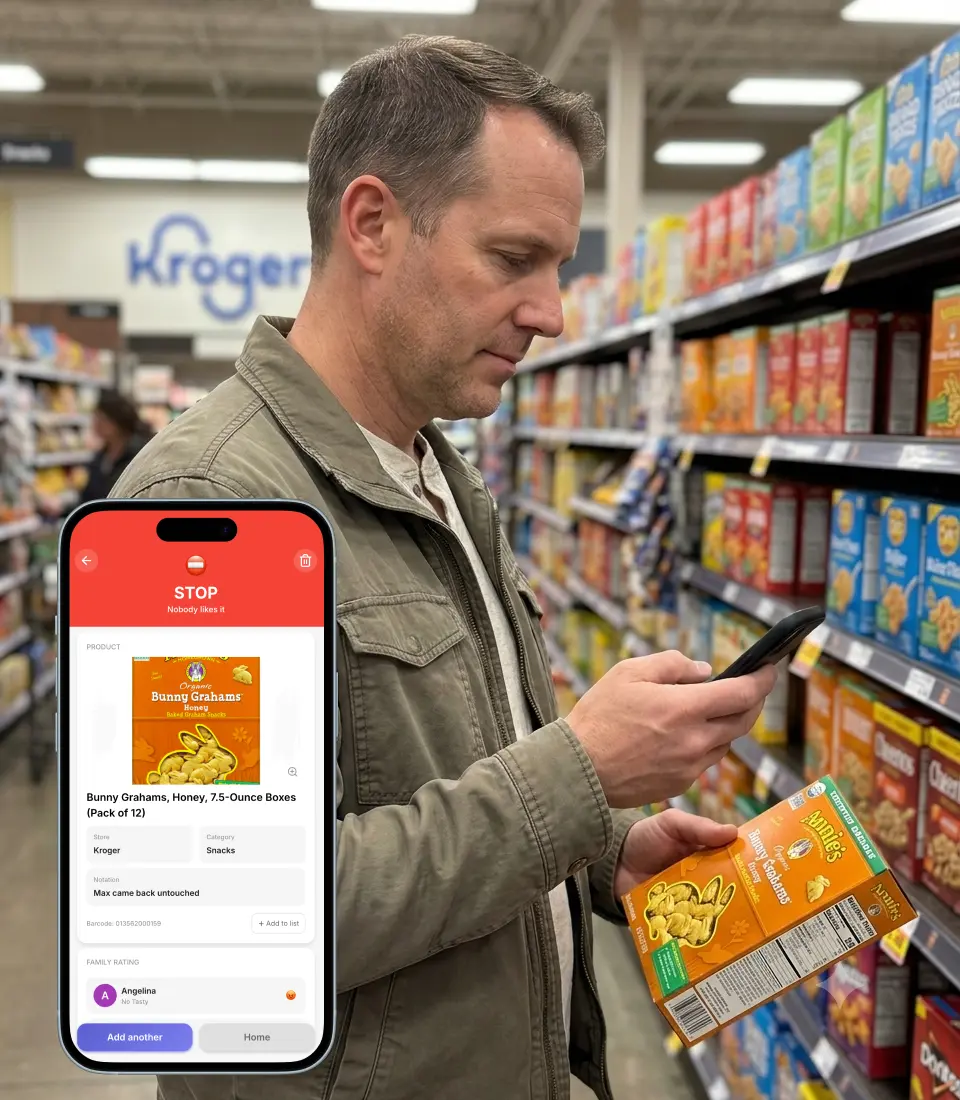
And if you're standing in the aisle looking at two similar boxes of crackers, wondering which one your kid will actually open — you scan the barcode. Two seconds. The answer is already there. No phone call home. More on why parents keep buying the wrong school snacks.
Next September, you're not relying on memory anymore. You're relying on your family's history.
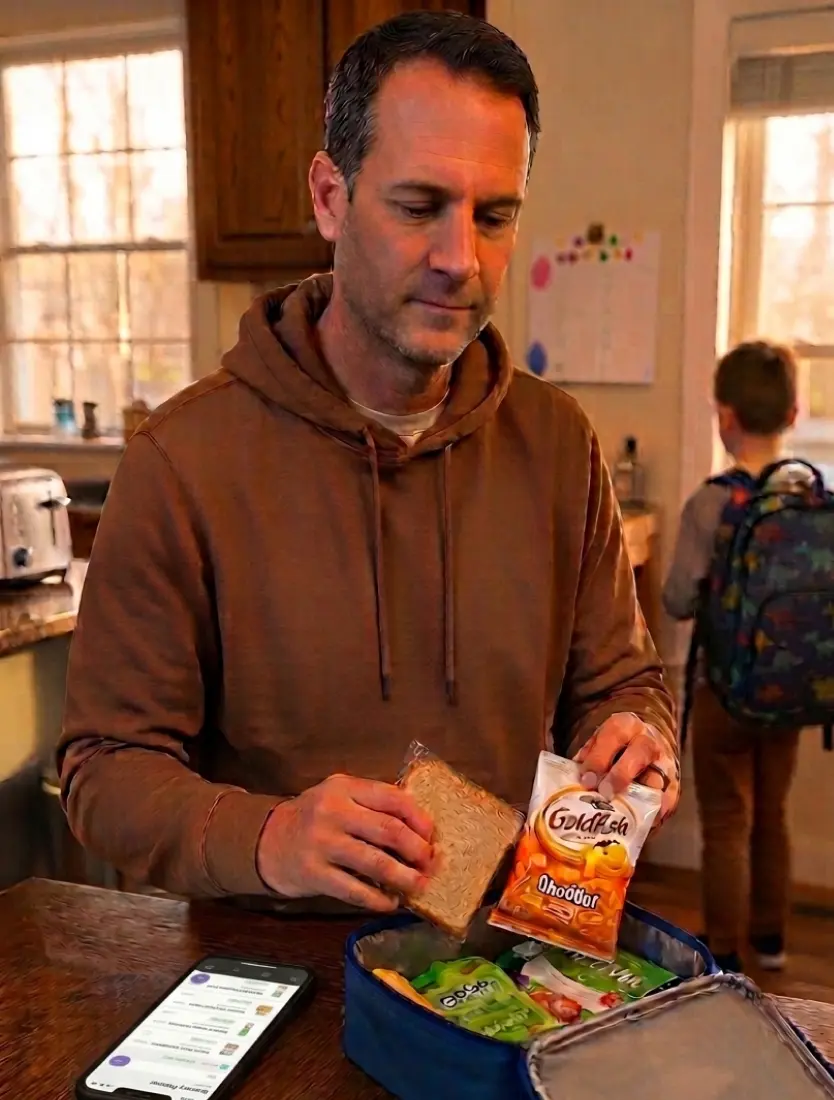
A practical back-to-school order
Two weeks before school: Check what's left from last school year. What did your child eat consistently at school? That's your starting list.
One week before school: Test everything new you plan to pack in the lunchbox at home first. If they won't eat it at home, they won't eat it at school.
First week of school: Pack only proven back-to-school snacks. The first week is stressful enough — don't add unfamiliar products.
After the first week: Check the lunchboxes. What came back — write it down. This is your real data about school lunch, not theory.
Don't buy large packs until you've confirmed a product has passed the school test.