
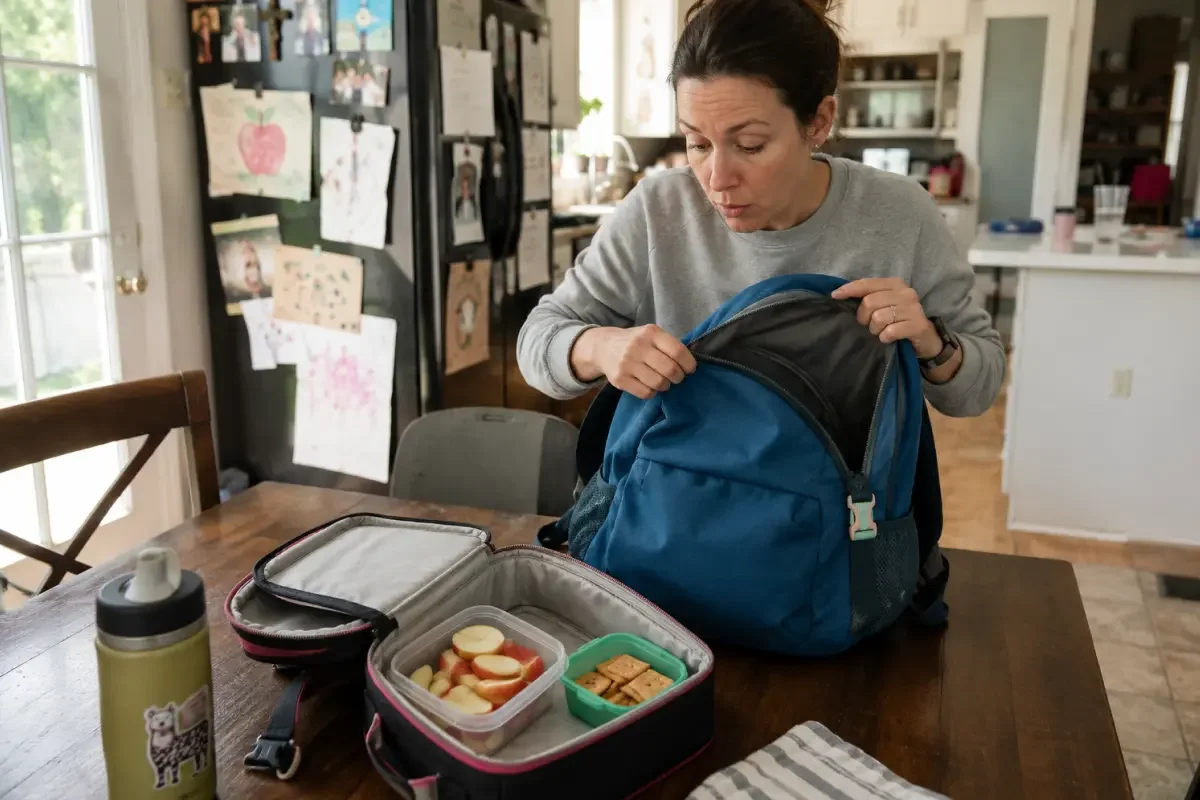
You open the backpack after school. The same snack you packed Monday is still there — and so is Tuesday's, and Wednesday's. Three days in a row. Untouched.
The same snack she eats at home. Apple slices — you watched her finish them at dinner just last week. But here it is: a full container, not even touched.
You ask why. She shrugs. "No time." Or "didn't feel like it." Or she just goes quiet.
The next day you pack the same thing. It comes back again. And you start to wonder if something's wrong with your kid — eats at home, won't eat at school.
But the problem isn't your child. And often it isn't even the snack. The problem is that a snack that works at home and a snack that works at school are two different things.
(One thing up front: this article is about kids from preschool through the early elementary years — roughly ages 3 to 9. For older kids and teens the issue is usually different: not context, but volume. In younger kids, it all comes down to time, packaging, and peers.)
Why a home snack fails at school
At home, your child eats in peace. As much time as they need. Familiar surroundings. You're right there to open a tricky package.
At school — none of that.
The snack break is 10 minutes. Sometimes less. Your child eats in noise, surrounded by twenty other kids, rushing to get back to playing. What took 20 unhurried minutes at home simply doesn't fit at school.
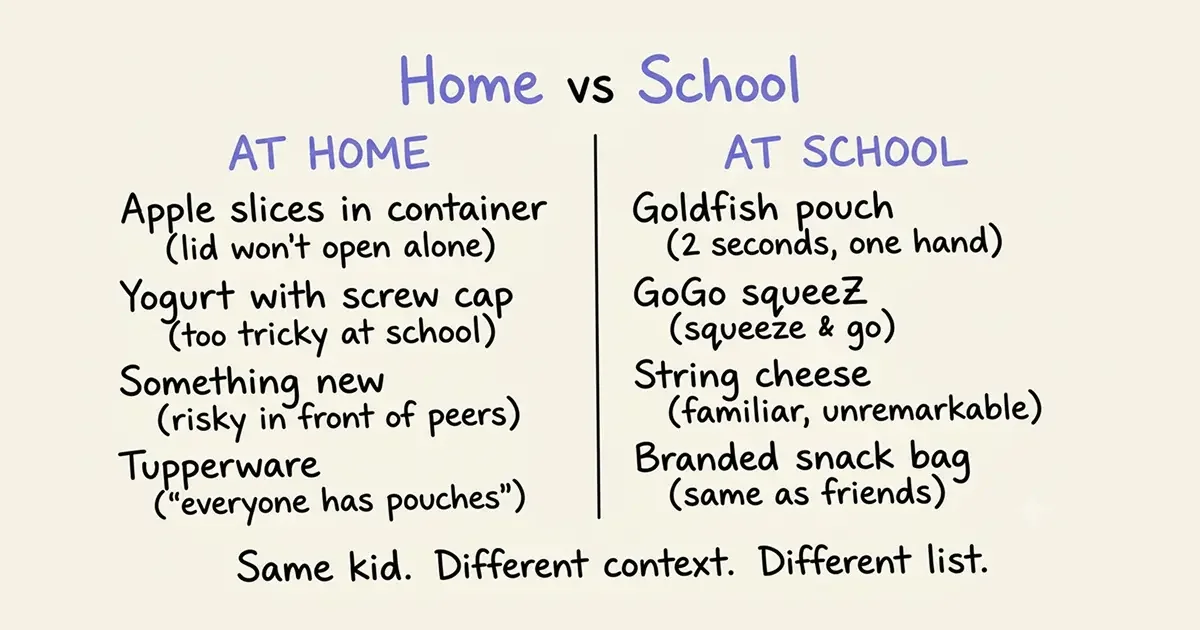
One dad told us something telling: his son kept bringing back a full container of yogurt every day. Turned out the kid couldn't open the lid himself and was too embarrassed to ask the teacher. The snack was perfect. The context wasn't.
That's the core difference. At home you control the conditions. At school your child is on their own, rushing, and doesn't want to stand out.
The younger the child, the sharper this gets. In preschool and the early grades the snack window is short, little hands still struggle with packaging, and the urge to "be like everyone else" is at its peak. By middle school kids are more independent, and the problem shifts from "couldn't / was embarrassed" to simply "how much to bring."
"Safe" snacks aren't what you think
In the stressful context of school, kids stick to the familiar. Dietitians call these "safe foods" — items a child will reliably accept with no risk.
At home, trying something new is safe. At school, it isn't. Trying an unfamiliar snack in front of peers who might comment is too risky for a lot of kids. So what you think of as "a fun new snack" often stays untouched specifically at school — even though your child would've eaten it at home.
Then there's the social layer. One mom wrote to us that her daughter stopped eating her favorite snack because "all the other kids have pouches and I have a container." Not taste. Not hunger. She just didn't want to stand out.
The best illustration is a small thing many parents notice: apple slices cut at home come back untouched, but the exact same fruit in a branded pouch — Bluey, PAW Patrol — gets eaten completely. Same fruit. The only difference is the packaging. To a kid, that's not a small thing.
A "healthy" snack that makes perfect sense to you at home can fail at school for reasons that have nothing to do with how nutritious it is.
The question worth asking
Most school-snack advice answers the question "which snack is healthy." (If you're also packing full lunches, we went deeper on that in school lunch ideas for picky eaters.)
But that's not the question that solves the full-container problem.
The real question: which snack will my child actually eat in 10 minutes, in a noisy room, surrounded by peers, possibly unable to ask for help with the packaging?
That's a narrower question. And the answer is often different from "what's nutritious." The snack needs to be:
Fast
Eaten in minutes, no sitting and picking at it required.
Self-serve
Your child opens it alone. No lids that jam, no wrappers that tear in the wrong place.
Familiar
School isn't the place for experiments. Pack proven safe snacks; save new foods for home.
Unremarkable
Something that doesn't make your child stand out. Sometimes that honestly matters more than nutrition.
How to figure out what actually works at school
Here's the catch: you don't see your child eat at school. You only see the result — what came back, what didn't.
So the only way to understand the school-safe list is to track results. Not what your child likes at home, but what consistently comes back empty from school.
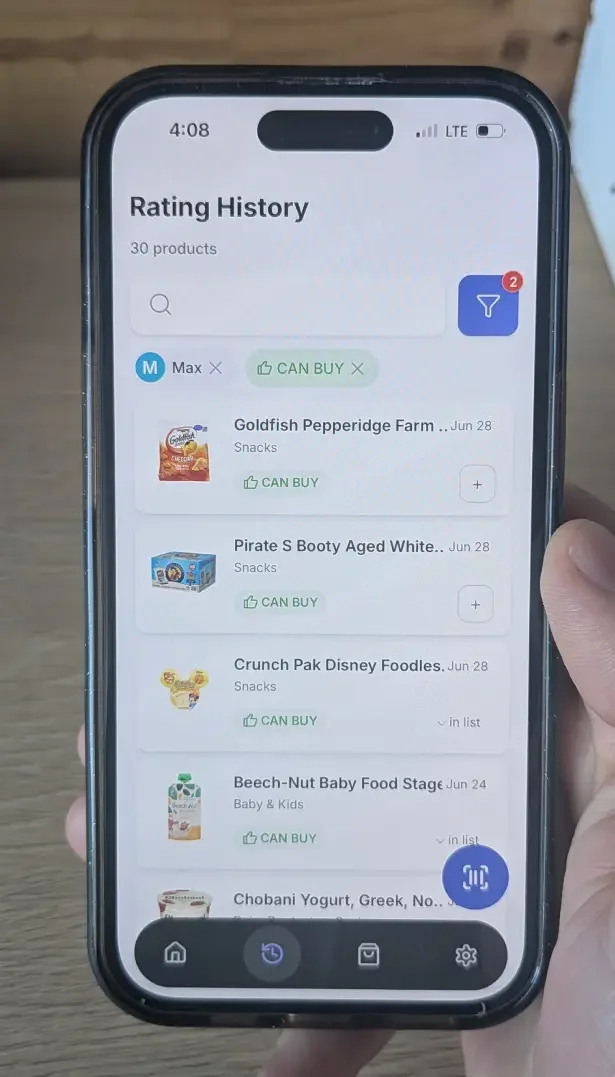
We started writing it down. What I packed — what came back eaten — what came back untouched. After two weeks a pattern showed up: a set of 6–7 snacks that reliably worked at school. The rest came back.
At first these were just notes. Then we moved to Favory — I scan the snack, give it a rating, but tagged with whether it's a "school" result. That way the school-safe list lives separately from the home food list. Because they really are different lists.
Now when I'm at the store picking snacks for the week, I'm not looking at what my kid likes in general — I'm looking at what actually comes back empty from school.
Snacks that more often survive school
This isn't a universal list — every kid is different. But here's what parents actually pack and what consistently comes back empty.
Familiar snacks in packages
Goldfish, Cheez-Its, Pirate's Booty, pretzels. Your child sees them in friends' lunches, opens them easily, eats them one-handed. Unremarkable works at any age.
Cheese and protein, single-serve
String cheese, ready snack trays like Crunch Pak (apple + cheese + crackers in one pack). The child opens it alone.
Fruit that doesn't run
Grapes, banana, mandarin, apple slices — but often in a branded pouch rather than a home container. GoGo squeeZ applesauce pouches are steady too.
Uncrustables and the like
A frozen PB&J that thaws by lunch — one of the most popular US school snacks precisely because of zero prep and a familiar taste. (Just check whether your school has a strict nut-free policy first — many US and Canadian schools do. If so, look for the sunflower seed butter versions, like SunButter, which are made for exactly this.)
One small age note. For preschool and daycare, also think about safety: cut things small (grapes halved), and for many kids this age it's critical that foods don't touch — hence the popularity of bento boxes with compartments. Early-grade kids tend to like the "build it yourself" format — crackers, cheese, sliced meat packed separately, like a homemade Lunchable.
Important: even from this list — don't guess. Pack it, see what comes back, draw your conclusion. The list above is a starting point, not the answer.